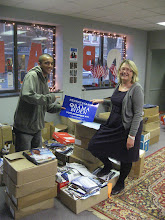
Spotted in a shop window in Harlem:
Rosa Parks sat
So that Martin Luther could walk
So that Barack Obama could run
So that our children could fly
Thursday, November 13, 2008


Sunday, November 9, 2008
A knockout
Fifteen-year-old Mike Horton Jr is in no doubt about the importance of Barack Obama’s victory.
As we packed away the campaign leftovers – thousands of unused leaflets, boxes of marker pens and a bag of badges declaring “Catholics for Obama” - he turned to me and said: “You know, if Barack hadn’t knocked out McCain, if we had lost on Tuesday, we would have lost everything, everything.”
He then went on to set out a complicated boxing metaphor, involving, I think, Larry Holmes, Gerry Cooney and a knockout in round thirteen. Holmes won, so I got the gist of what he was trying to say.
Winning on points was never going to be enough for Obama’s supporters, we had to win decisively, and on Tuesday night, at around 11.00 pm, only three short hours after the polls had closed in Pennsylvania, we got the knockout punch we wanted.
“ Barack Obama is projected to be the next President of the United States of America,” announced MSNBC’s Keith Olbermann, his voice shaking with emotion.
Olbermann, a former award-winning sports presenter, hosts Countdown, a nightly current affairs programme on a major cable news channel.
He loves Barack, hates the Republican Party, Fox News and hypocrites, and revels in his partisanship. I love him.
So does young Mike, but not as much as he loves Barack Obama. While most fifteen-year-olds spend their evenings and weekends instant messaging their friends, Mike has spent his free time working for an Obama victory.
Nine months ago he walked into the newly opened Obama campaign office in Bethlehem’s Main Street and signed up as a volunteer.
“Minorities have been overlooked in this country for too long,” he explained as we took down a poster bearing the legend “Hope”.
“We need change in health and education. I think the bad things that people do are just a symptom of how bad their lives are. Barack will change that.”
Mike’s high expectations are shared by millions of people across the USA, many of whom voted for the first time in this election.
In the 2004 Presidential election only 12 percent of the students at Bethlehem’s Lehigh University bothered to vote. This time 85 per cent voted.
Obama’s message of hope also mobilised African-American voters in a way never seen before. He won 95% of the black vote, compared to just 4% for Mr McCain.
And experts say his appeal to women – from all backgrounds - was one of the most important factors in his victory.
In his masterful speech early on Wednesday morning, President-elect Obama tried to dampen down the people’s expectations.
“The road ahead will be long. Our climb will be steep. We may not get there in one year or even one term…
There will be setbacks and false starts…and we know that government can't solve every problem.”
And with the news that unemployment has hit a 14 year high and that American’s iconic brand General Motors has posted a $2.5 BILLION loss in the last quarter, the road ahead will be long, and hard.
But for Mike, the future has never looked brighter.
He is the youngest of seven children, his mother is a single parent, and like many young men, he sometimes struggles to keep his cool.
But he has a dream.
“I want to go to Harvard Law School, then set up a non-profit, for kids like me. Somewhere they can get support, and I can help them succeed.”
Last week his dream was just that, a dream.
Today as Barack Obama, an African American man, the son of a single parent, gets ready to move into the White House, Mike knows his dream will come true.
As we packed away the campaign leftovers – thousands of unused leaflets, boxes of marker pens and a bag of badges declaring “Catholics for Obama” - he turned to me and said: “You know, if Barack hadn’t knocked out McCain, if we had lost on Tuesday, we would have lost everything, everything.”
He then went on to set out a complicated boxing metaphor, involving, I think, Larry Holmes, Gerry Cooney and a knockout in round thirteen. Holmes won, so I got the gist of what he was trying to say.
Winning on points was never going to be enough for Obama’s supporters, we had to win decisively, and on Tuesday night, at around 11.00 pm, only three short hours after the polls had closed in Pennsylvania, we got the knockout punch we wanted.
“ Barack Obama is projected to be the next President of the United States of America,” announced MSNBC’s Keith Olbermann, his voice shaking with emotion.
Olbermann, a former award-winning sports presenter, hosts Countdown, a nightly current affairs programme on a major cable news channel.
He loves Barack, hates the Republican Party, Fox News and hypocrites, and revels in his partisanship. I love him.
So does young Mike, but not as much as he loves Barack Obama. While most fifteen-year-olds spend their evenings and weekends instant messaging their friends, Mike has spent his free time working for an Obama victory.
Nine months ago he walked into the newly opened Obama campaign office in Bethlehem’s Main Street and signed up as a volunteer.
“Minorities have been overlooked in this country for too long,” he explained as we took down a poster bearing the legend “Hope”.
“We need change in health and education. I think the bad things that people do are just a symptom of how bad their lives are. Barack will change that.”
Mike’s high expectations are shared by millions of people across the USA, many of whom voted for the first time in this election.
In the 2004 Presidential election only 12 percent of the students at Bethlehem’s Lehigh University bothered to vote. This time 85 per cent voted.
Obama’s message of hope also mobilised African-American voters in a way never seen before. He won 95% of the black vote, compared to just 4% for Mr McCain.
And experts say his appeal to women – from all backgrounds - was one of the most important factors in his victory.
In his masterful speech early on Wednesday morning, President-elect Obama tried to dampen down the people’s expectations.
“The road ahead will be long. Our climb will be steep. We may not get there in one year or even one term…
There will be setbacks and false starts…and we know that government can't solve every problem.”
And with the news that unemployment has hit a 14 year high and that American’s iconic brand General Motors has posted a $2.5 BILLION loss in the last quarter, the road ahead will be long, and hard.
But for Mike, the future has never looked brighter.
He is the youngest of seven children, his mother is a single parent, and like many young men, he sometimes struggles to keep his cool.
But he has a dream.
“I want to go to Harvard Law School, then set up a non-profit, for kids like me. Somewhere they can get support, and I can help them succeed.”
Last week his dream was just that, a dream.
Today as Barack Obama, an African American man, the son of a single parent, gets ready to move into the White House, Mike knows his dream will come true.
Wednesday, November 5, 2008
Our shared destiny
The world changed yesterday - for good.
Barack Obama is not Superman. Poverty will not disappear overnight. Peace will not reign across the world by Christmas. And prejudice will continue to stalk our communities.
But we now have hope, hope that we can all make the world a better place. We can now believe that dreams do come true, and that change is possible.
All we have to do is make it happen.
President-elect Obama's words are much more eloquent than mine.
His acceptance speech last night was masterful...
...And to all those watching tonight from beyond our shores, from parliaments and palaces to those who are huddled around radios in the forgotten corners of our world - our stories are singular, but our destiny is shared, and a new dawn of American leadership is at hand. To those who would tear this world down - we will defeat you. To those who seek peace and security - we support you. And to all those who have wondered if Americas beacon still burns as bright - tonight we proved once more that the true strength of our nation comes not from our the might of our arms or the scale of our wealth, but from the enduring power of our ideals: democracy, liberty, opportunity, and unyielding hope...
Yes we can.
Barack Obama is not Superman. Poverty will not disappear overnight. Peace will not reign across the world by Christmas. And prejudice will continue to stalk our communities.
But we now have hope, hope that we can all make the world a better place. We can now believe that dreams do come true, and that change is possible.
All we have to do is make it happen.
President-elect Obama's words are much more eloquent than mine.
His acceptance speech last night was masterful...
...And to all those watching tonight from beyond our shores, from parliaments and palaces to those who are huddled around radios in the forgotten corners of our world - our stories are singular, but our destiny is shared, and a new dawn of American leadership is at hand. To those who would tear this world down - we will defeat you. To those who seek peace and security - we support you. And to all those who have wondered if Americas beacon still burns as bright - tonight we proved once more that the true strength of our nation comes not from our the might of our arms or the scale of our wealth, but from the enduring power of our ideals: democracy, liberty, opportunity, and unyielding hope...
Yes we can.
Sunday, November 2, 2008
Change the world
With only 48 hours until the polls open at 7am on Tuesday morning the well oiled machine that is Pennsylvania for Change has sprung into action.
Our exhausted field officers, Ken, Katie and Ryan have organised teams of volunteers to knock on the door of every Obama supporter in Northampton County and remind them to get out to vote.
Door hangers exhorting voters to make their mark on November 4th are being hung on every front door, just in case someone, somewhere, has forgotten that Tuesday is decision day.
Supporters drop by with boxes of bran muffins and cheese crackers. Phones ring off the hook, literature piles up alongside Google maps of canvassing routes and Obama stickers and in a few hours time Caroline Kennedy, daughter of that most iconic of Presidents, Jack Kennedy will drop by to wish everyone good luck.
An air of quiet determination pervades the office. The polls still predict an Obama win in Pennsylvania, with the margin of victory ranging from seven to ten per cent, but nothing is being taken for granted.
The word victory doesn’t pass anyone’s lips. Memories of the 2000 election and those hanging chads that robbed Al Gore of victory are still too fresh in most Democrats’ minds.
“We are not going to let up until the polls close at 8pm, and if the campaign needs us, we will hit the phones out west, their polls don’t close until 11 pm our time” Ken tells us.
We all nod in agreement. We are here to do what we are told - all of us - from Rob, who works part time in a Bethlehem bookstore to Martha, a film technician from downtown New York.
Martha’s job is to co-ordinate the out of state volunteers. “Where do you think I should put this guy?” she asks. “He has a car, will work right through to election day and is happy to do anything.”
He ends up in the same area as me. I am in the Hellertown area that has some nine thousand voters. It is a socially mixed community, just like Edinburgh Pentlands where I cut my political teeth – blue collar workers in town and very large, very beautiful homes in the countryside surrounding it.
But just as the Labour Party in 1997 successfully targeted all voters, from hard-core supporters to disillusioned Tories, so Obama’s campaign has broad based appeal.
Last Tuesday morning I was lucky enough to hear him make his solemn promise to unite America at a rally in Chester, on the outskirts of Philadelphia.
It was one of the wet, wet days, when the rain and wind chill you to the bone, but the thousands of people who stood cheerfully in line for two hours shrugged off the weather.
Young black teenagers in hoodies chatted, probably for the first time in their lives to middle-aged, middle class white women in North Face jackets, as together, we waited to hear the man who promises to change this country for good.
It was worth risking pneumonia.
He stood before us, bare-headed in the rain, his deep, rich voice resonating across the sports field as he wove his compelling story for change.
He ended with this call to action: “if you will stand with me, and fight with me, and give me your vote, then I promise you this – we will not just win Pennsylvania, we will not just win this election, but together, we will change this country and we will change the world.”
Senator John McCain was due to speak the same morning in Pennsylvania, but cancelled because of the rain. Think about it, who would you vote for?
Our exhausted field officers, Ken, Katie and Ryan have organised teams of volunteers to knock on the door of every Obama supporter in Northampton County and remind them to get out to vote.
Door hangers exhorting voters to make their mark on November 4th are being hung on every front door, just in case someone, somewhere, has forgotten that Tuesday is decision day.
Supporters drop by with boxes of bran muffins and cheese crackers. Phones ring off the hook, literature piles up alongside Google maps of canvassing routes and Obama stickers and in a few hours time Caroline Kennedy, daughter of that most iconic of Presidents, Jack Kennedy will drop by to wish everyone good luck.
An air of quiet determination pervades the office. The polls still predict an Obama win in Pennsylvania, with the margin of victory ranging from seven to ten per cent, but nothing is being taken for granted.
The word victory doesn’t pass anyone’s lips. Memories of the 2000 election and those hanging chads that robbed Al Gore of victory are still too fresh in most Democrats’ minds.
“We are not going to let up until the polls close at 8pm, and if the campaign needs us, we will hit the phones out west, their polls don’t close until 11 pm our time” Ken tells us.
We all nod in agreement. We are here to do what we are told - all of us - from Rob, who works part time in a Bethlehem bookstore to Martha, a film technician from downtown New York.
Martha’s job is to co-ordinate the out of state volunteers. “Where do you think I should put this guy?” she asks. “He has a car, will work right through to election day and is happy to do anything.”
He ends up in the same area as me. I am in the Hellertown area that has some nine thousand voters. It is a socially mixed community, just like Edinburgh Pentlands where I cut my political teeth – blue collar workers in town and very large, very beautiful homes in the countryside surrounding it.
But just as the Labour Party in 1997 successfully targeted all voters, from hard-core supporters to disillusioned Tories, so Obama’s campaign has broad based appeal.
Last Tuesday morning I was lucky enough to hear him make his solemn promise to unite America at a rally in Chester, on the outskirts of Philadelphia.
It was one of the wet, wet days, when the rain and wind chill you to the bone, but the thousands of people who stood cheerfully in line for two hours shrugged off the weather.
Young black teenagers in hoodies chatted, probably for the first time in their lives to middle-aged, middle class white women in North Face jackets, as together, we waited to hear the man who promises to change this country for good.
It was worth risking pneumonia.
He stood before us, bare-headed in the rain, his deep, rich voice resonating across the sports field as he wove his compelling story for change.
He ended with this call to action: “if you will stand with me, and fight with me, and give me your vote, then I promise you this – we will not just win Pennsylvania, we will not just win this election, but together, we will change this country and we will change the world.”
Senator John McCain was due to speak the same morning in Pennsylvania, but cancelled because of the rain. Think about it, who would you vote for?
Sunday, October 26, 2008
Election fever in Bethlehem
As we checked into the hotel, the receptionist asked what had brought us to Bethlehem, Pennsylvania.
“We are here to help out in Barack Obama’s campaign,” I said, not quite sure what response I would get.
Back home, an admission of political activism is treated either with a bored “really?” or worse, down right hostility. I was in for a big surprise.
“Really ma’am, well let me give you a discount on your room. I hope you have a good time,” he said, grinning broadly.
Welcome to the United State of America, where the whole nation is gripped by the titanic battle between Senators Obama and McCain.
With only days to go to polling day, the pace is frenetic in Obama’s campaign office in Main Street.
Bethlehem is in Northampton County, a key district. The polls show Obama has a big lead in the state, but news that John McCain has decided to abandon several previously Republican states and try and grab Pennsylvania’s 21 electoral college votes has brought a new urgency to the campaign.
Nothing is being left to chance.
Volunteers are busy calling voters or knocking on doors to remind them to go out on vote on November 4th.
The three field officers, Ken, Ryan and Katie are organising their teams for the last big push which begins next Saturday.
“Get all the sleep you can,” Ken told us at a training session last night, “because next week, we aren’t going to go to bed.”
And throughout the day a steady stream of people pop in, looking for badges, t-shirts, yard signs, anything so they can show their support for the dream ticket of Obama-Biden.
I spent this morning with Marion, a great grandmother, collating canvassing packs, stuffing them full of leaflets explaining Obama’s plans for economic recovery.
With Wall Street in free fall, a recession looming, nothing else matters. This election is not about Sarah Palin’s wardrobe or McCain’s foreign policy experience. It is the economy, stupid.
Tomorrow I will hit the streets for the first time. Knocking doors usually holds no fears for me. My first election was in 1983 and over the years I have encountered everything, from dangerous dogs to naked men, even a few Tories. But I worry that my Scottish accent will confuse the good people of Bethlehem.
“Just speak slowly,” Ken advises me, so for the rest of the afternoon I am going to practice my script: “Hello, I am stopping by today because the election is just around the corner, and I want to do everything I can to earn your vote on behalf of Senator Obama.”
Doing everything I can has meant spending the last of my savings to fly out to the USA for three weeks to help elect the man I believe will change, not only the United States of America, but the world.
Not since 1997 has an election mattered so much.
If Obama wins, the USA will be able to hold its head high again, with a President who understands how the real world works. Not just because his mother was from Kansas and his father from Kenya and he went to school in Indonesia and Hawaii, but because his policies and values are what the world needs now.
My mother texted me this morning to ask if I would get to meet the candidate.
“No chance,” I replied, “but I don’t care, I am having the best experience of my life, and on 4 November, things really will start to get better.”
“We are here to help out in Barack Obama’s campaign,” I said, not quite sure what response I would get.
Back home, an admission of political activism is treated either with a bored “really?” or worse, down right hostility. I was in for a big surprise.
“Really ma’am, well let me give you a discount on your room. I hope you have a good time,” he said, grinning broadly.
Welcome to the United State of America, where the whole nation is gripped by the titanic battle between Senators Obama and McCain.
With only days to go to polling day, the pace is frenetic in Obama’s campaign office in Main Street.
Bethlehem is in Northampton County, a key district. The polls show Obama has a big lead in the state, but news that John McCain has decided to abandon several previously Republican states and try and grab Pennsylvania’s 21 electoral college votes has brought a new urgency to the campaign.
Nothing is being left to chance.
Volunteers are busy calling voters or knocking on doors to remind them to go out on vote on November 4th.
The three field officers, Ken, Ryan and Katie are organising their teams for the last big push which begins next Saturday.
“Get all the sleep you can,” Ken told us at a training session last night, “because next week, we aren’t going to go to bed.”
And throughout the day a steady stream of people pop in, looking for badges, t-shirts, yard signs, anything so they can show their support for the dream ticket of Obama-Biden.
I spent this morning with Marion, a great grandmother, collating canvassing packs, stuffing them full of leaflets explaining Obama’s plans for economic recovery.
With Wall Street in free fall, a recession looming, nothing else matters. This election is not about Sarah Palin’s wardrobe or McCain’s foreign policy experience. It is the economy, stupid.
Tomorrow I will hit the streets for the first time. Knocking doors usually holds no fears for me. My first election was in 1983 and over the years I have encountered everything, from dangerous dogs to naked men, even a few Tories. But I worry that my Scottish accent will confuse the good people of Bethlehem.
“Just speak slowly,” Ken advises me, so for the rest of the afternoon I am going to practice my script: “Hello, I am stopping by today because the election is just around the corner, and I want to do everything I can to earn your vote on behalf of Senator Obama.”
Doing everything I can has meant spending the last of my savings to fly out to the USA for three weeks to help elect the man I believe will change, not only the United States of America, but the world.
Not since 1997 has an election mattered so much.
If Obama wins, the USA will be able to hold its head high again, with a President who understands how the real world works. Not just because his mother was from Kansas and his father from Kenya and he went to school in Indonesia and Hawaii, but because his policies and values are what the world needs now.
My mother texted me this morning to ask if I would get to meet the candidate.
“No chance,” I replied, “but I don’t care, I am having the best experience of my life, and on 4 November, things really will start to get better.”
Tuesday, October 14, 2008
Men's work
Julia looked sceptical, in a way only a wise nine year old can.
“Can I carry the water on my head?” I asked, pointing at the orange plastic bucket she had just filled with fresh water from Lake Malawi.
She spoke quickly in Chichewa to her friends, who all burst out laughing. The white mamma was going to carry water on her head. How funny. How very stupid.
With Julia’s help I manoeuvred the heavy bucket onto my head, and walking very slowly I managed a few shaky yards along the beach, then turned and made my way back, trying hard not to spill a drop while cursing the weak muscles in my upper arms, damaged by years of typing.
She laughed as she took the bucket back.
“Do the boys not work, help you carry water?” I asked Julia, knowing full well what her answer would be.
She looked even more sceptical. Was the white mamma really this stupid?
Again she translated for her friends, who laughed even louder at my eccentricity.
“Boys not carry water,” she replied. “They not work, they play,’’ as if this was the natural order of things – which it seems to be in large parts of Malawi.
Women and girls fetch water, sometimes carrying heavy buckets for miles.
Women and girls cultivate the land, growing food to feed their families.
They prepare the meals, clean the home, have babies, look after sick relatives, and of course, keep their menfolk happy in every way.
Men do work, but jobs in the formal economy are rare, so most wile away the daylight hours lounging under trees, playing boa, a traditional board game, drinking chibuku, a traditional beer, chewing the fat with their friends, content to let the womenfolk toil away in the African sun.
It is the natural order of things.
Al, one of the young Americans to whom we gave a lift yesterday, is particularly perturbed by this aspect of Malawian culture.
As a Peace Corps volunteer he lives in a village so witnesses this gender gap every day.
“I just don’t get it,” he says. “These strong men let the women do all the work, while they drink beer and play games.
“I tell the young boys my mother would be very angry if I treated her with such lack of respect.”
He is rightly proud of his efforts to persuade some of his younger friends in the village that carrying water is not women’s work.
“They watched me carrying water and asked why I didn’t have a wife to do it for me.
“I told them it was men’s work and made me strong. I showed them my muscles, so now I have a couple of them carrying water, so they can build up their muscles.
“But hey, I just don’t get the rest of the guys.”
A quick look at Malawi’s economic statistics explains why the rest of the guys spend their time hanging around. They make stark reading.
“Can I carry the water on my head?” I asked, pointing at the orange plastic bucket she had just filled with fresh water from Lake Malawi.
She spoke quickly in Chichewa to her friends, who all burst out laughing. The white mamma was going to carry water on her head. How funny. How very stupid.
With Julia’s help I manoeuvred the heavy bucket onto my head, and walking very slowly I managed a few shaky yards along the beach, then turned and made my way back, trying hard not to spill a drop while cursing the weak muscles in my upper arms, damaged by years of typing.
She laughed as she took the bucket back.
“Do the boys not work, help you carry water?” I asked Julia, knowing full well what her answer would be.
She looked even more sceptical. Was the white mamma really this stupid?
Again she translated for her friends, who laughed even louder at my eccentricity.
“Boys not carry water,” she replied. “They not work, they play,’’ as if this was the natural order of things – which it seems to be in large parts of Malawi.
Women and girls fetch water, sometimes carrying heavy buckets for miles.
Women and girls cultivate the land, growing food to feed their families.
They prepare the meals, clean the home, have babies, look after sick relatives, and of course, keep their menfolk happy in every way.
Men do work, but jobs in the formal economy are rare, so most wile away the daylight hours lounging under trees, playing boa, a traditional board game, drinking chibuku, a traditional beer, chewing the fat with their friends, content to let the womenfolk toil away in the African sun.
It is the natural order of things.
Al, one of the young Americans to whom we gave a lift yesterday, is particularly perturbed by this aspect of Malawian culture.
As a Peace Corps volunteer he lives in a village so witnesses this gender gap every day.
“I just don’t get it,” he says. “These strong men let the women do all the work, while they drink beer and play games.
“I tell the young boys my mother would be very angry if I treated her with such lack of respect.”
He is rightly proud of his efforts to persuade some of his younger friends in the village that carrying water is not women’s work.
“They watched me carrying water and asked why I didn’t have a wife to do it for me.
“I told them it was men’s work and made me strong. I showed them my muscles, so now I have a couple of them carrying water, so they can build up their muscles.
“But hey, I just don’t get the rest of the guys.”
A quick look at Malawi’s economic statistics explains why the rest of the guys spend their time hanging around. They make stark reading.
- only 29% of the workforce are employed in activities other than subsistence farming
- a mere 11% receive wages or salaries, while 13% are self-employed
- just 8% work in private industry, with 3% each in manufacturing and construction
- only 7% are qualified to secondary school level and above, while 70% have no qualifications at all – four-fifths of the latter group are engaged in subsistence agriculture
Wednesday, October 1, 2008
Village voices
Jack took the newspapers with a shy smile. “Thank you very much,” he said. “Here in the village we don’t get to see the newspapers every day, and I like my news.”
He sat back in his chair. “I lived in the city for over forty years, it is nice to be back home, it is quiet here, peaceful.”
Jack is 70, and lives in Kadaya, a village in the Thyolo district of Malawi. For decades he lived and worked as a welder in Blantyre, the country’s largest city.
He was a town man. But as old age approached, he and his wife decided it was time to return to their roots. Back to the village, where over fifty years ago, he had charmed her into marrying him against her family’s wishes.
“He was a very naughty boy when he was a teenager,” laughed Thoko, his daughter, as we drove past the luscious green tea plantations on our way to visit her parents.
“They met at the market place. Every Saturday someone would bring out a radiogram and play music. All the young people would dance, and relationships would start.”
This particular relationship resulted in eight children, seven girls and one boy.
“I educated all the girls,” Jack told me. “It was hard work, paying their school fees, but it was important to me.”
And to his country. Jack’s seven girls, now women, are all professional women working as nurses, teachers, or with NGOs such as Save the Children. All have stayed in Malawi, each making an invaluable contribution to their country’s development.
Jack was just about to tell us about the years he spent in Zimbabwe, “it was Rhodesia then of course”, when a small woman with a very loud voice burst through the open door.
“Hello mama,” she shouted. “I am Annie, I speak very good English, I can come and work for you. I am very good.”
“Eeeeh, this is my aunt,” laughed Thoko. “My mother’s sister.”
Annie took over.
Teaching me how to dance like a village woman.
“Move your hips like this,” she shouted, while grabbing hold of them.
Showing us her green maize.
“My garden is only a few minutes walk,” she promised. It took us half an hour to reach her plot of land, “only a few more yards,” she shouted every five minutes.
Introducing us to her many relatives.
“This is my eldest daughter, Miriam.
“My second son, Charles.”
“ My oldest aunt, Elizabeth.”
Telling us about her violent husband.
“He used to beat me. So I said enough, and left him. I came back to my village with my children, and then divorced him. He was not happy,” she laughed.
Admiring my ample backside.
“I want to be fat like you,” she exclaimed. “If you are fat, it means you are rich.”
She finally fell silent as we sat down to lunch, but only long enough to eat four portions of nsima and two pieces of chicken. Growing maize is hungry work.
“I am going to come to Scotland with you,” she announced as she polished off the last of the nsima.
“I will get fat there. I want to be fat.”
He sat back in his chair. “I lived in the city for over forty years, it is nice to be back home, it is quiet here, peaceful.”
Jack is 70, and lives in Kadaya, a village in the Thyolo district of Malawi. For decades he lived and worked as a welder in Blantyre, the country’s largest city.
He was a town man. But as old age approached, he and his wife decided it was time to return to their roots. Back to the village, where over fifty years ago, he had charmed her into marrying him against her family’s wishes.
“He was a very naughty boy when he was a teenager,” laughed Thoko, his daughter, as we drove past the luscious green tea plantations on our way to visit her parents.
“They met at the market place. Every Saturday someone would bring out a radiogram and play music. All the young people would dance, and relationships would start.”
This particular relationship resulted in eight children, seven girls and one boy.
“I educated all the girls,” Jack told me. “It was hard work, paying their school fees, but it was important to me.”
And to his country. Jack’s seven girls, now women, are all professional women working as nurses, teachers, or with NGOs such as Save the Children. All have stayed in Malawi, each making an invaluable contribution to their country’s development.
Jack was just about to tell us about the years he spent in Zimbabwe, “it was Rhodesia then of course”, when a small woman with a very loud voice burst through the open door.
“Hello mama,” she shouted. “I am Annie, I speak very good English, I can come and work for you. I am very good.”
“Eeeeh, this is my aunt,” laughed Thoko. “My mother’s sister.”
Annie took over.
Teaching me how to dance like a village woman.
“Move your hips like this,” she shouted, while grabbing hold of them.
Showing us her green maize.
“My garden is only a few minutes walk,” she promised. It took us half an hour to reach her plot of land, “only a few more yards,” she shouted every five minutes.
Introducing us to her many relatives.
“This is my eldest daughter, Miriam.
“My second son, Charles.”
“ My oldest aunt, Elizabeth.”
Telling us about her violent husband.
“He used to beat me. So I said enough, and left him. I came back to my village with my children, and then divorced him. He was not happy,” she laughed.
Admiring my ample backside.
“I want to be fat like you,” she exclaimed. “If you are fat, it means you are rich.”
She finally fell silent as we sat down to lunch, but only long enough to eat four portions of nsima and two pieces of chicken. Growing maize is hungry work.
“I am going to come to Scotland with you,” she announced as she polished off the last of the nsima.
“I will get fat there. I want to be fat.”
Subscribe to:
Posts (Atom)